Slow direct bookings usually mean a brand problem before a traffic problem. A guest who reaches your website, Instagram, and Airbnb listing should find one recognizable business with a specific reason to book, and a reason to book on your own site. Audit those six things before you pay for more visitors.
Airbnb is moving all home hosts to a single service fee, and under it most hosts pay 15.5% on every booking. The platform also keeps the guest: the email address and the rebooking. Direct bookings are how you stop renting your brand from Airbnb.
When they arrive slowly, the usual response is more of everything: more posts, a paid campaign, a discount. All of it sends more people to the same pages. If those pages don't make the case for booking, you've paid to show more people something that doesn't convert.
The audit below takes about an hour. Open your website, your Instagram profile, and your Airbnb listing in three tabs, plus your Google Business Profile if you have one. Then work through six checks, in this order.
Why should a guest book direct instead of on Airbnb?
Start here, because it decides whether direct bookings happen at all. The other five checks make your site more persuasive. This one gives a guest a reason to leave a platform they already trust.
Look at your homepage and booking page and find the stated reason to book on your site. The failing versions are easy to spot. Some sites give no reason, so the page works as a second copy of the listing with a different button. Some offer a vague “book direct for the best rate.” Some run a discount with no story behind it, which teaches guests to wait for the next one.
On the platform, the guest has reviews, payment protection, and a checkout they have used before. Your site has to offer what the platform can't: a direct line to the host, arrival details and add-on experiences the listing has no place for, a return-guest arrangement. Finish the sentence “Book here because ___” in plain words and put it next to the booking button. If you can't finish it, that is your first finding.
Does your website look like the same business as your Instagram and listing?
Guests move between these surfaces in a single sitting. They watch a reel, tap through to the site, and go back to the listing to check reviews. If the name is styled three ways, the photos come from three different shoots, and the tone shifts from warm on Instagram to brochure on the site, the guest has to work out whether this is one business. Some conclude it isn't. Some conclude it's unfinished, and unfinished is a hard sell at a nightly rate.
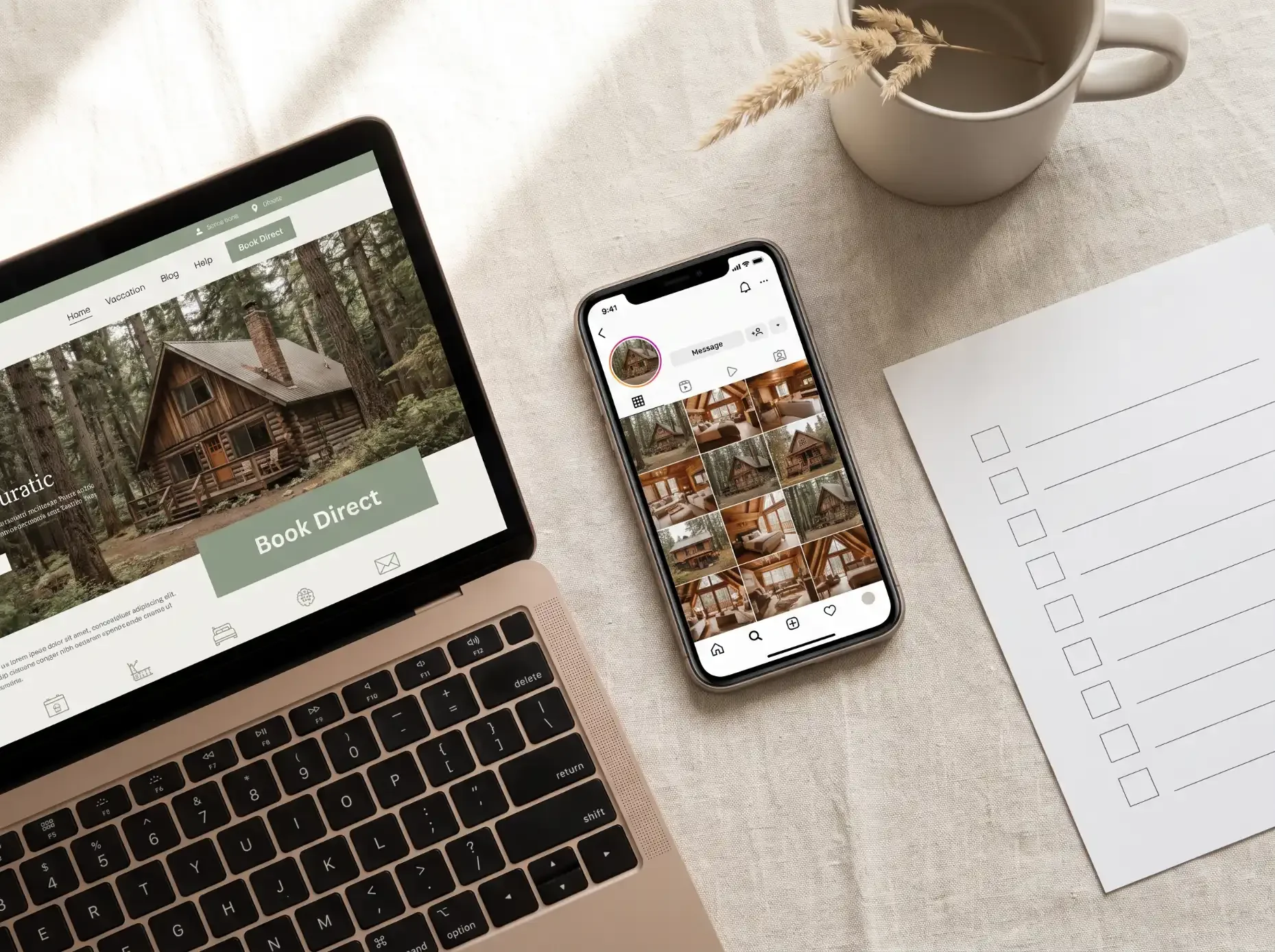
Put the three side by side and compare the name and logo, the colors, the photography, and how the copy sounds. Pick the strongest of the three and move the other two toward it. Start with the website, the one surface you control completely.
Are you selling the property or the trip?
Bedroom count, bathrooms, sleeps six, hot tub. Guests need those facts, and every listing in your market has them. A page built around specs answers whether the property fits and leaves open why this trip.
Read the first screen of your homepage. Who is this stay for, and what is it for? “A long weekend for two who want quiet” gives a guest something to recognize themselves in. “Sleeps six, three bedrooms” gives them a checklist. Keep the specs and move them below the story and onto the booking page, where a guest who has already decided goes looking for them. Then rewrite your opening paragraph for one specific type of guest.
Could a competitor's name replace yours without anyone noticing?
Copy your homepage headline and first paragraph into a note. Swap your property name for the name of a rental down the road. If it still reads correctly, the copy is generic.
The usual culprits are phrases like “the perfect getaway” and “everything you need for a relaxing stay.” Those lines fit every rental in the county. What does the work is a detail only your property has: what the kitchen is stocked with, the trail you'd send a first-time guest to. Replace each generic phrase with one of those. Then ask a past guest what they told their friends about the stay, and check whether it appears anywhere on your site.
Do your photos show the stay you want booked?
Most rental photo sets document the space: every room, straight on, well lit, in the order a floor plan would list them. Guests need that to trust the listing. It doesn't show them what a stay feels like or who it's for.

Pull the first ten photos a guest sees across your site, listing, and Instagram grid, and ask what kind of guest each one attracts. Two mugs on a porch rail sell a different weekend than a wide shot of six beds. If the set attracts the wrong guest, or nobody in particular, more traffic brings more of the same. Reorder before you reshoot: choose the hero image and the first five photos on each surface from what you already have, then see what's missing.
What will a guest remember after they close the tab?
Imagine a guest who spent five minutes on your site and went back to comparing. What is the one thing they remember? If you can't say it in a sentence, they can't either.
The answer is rarely a feature. It's a position: the quiet one, or the one built for groups. It only works when it shows up in the property name, the first line of the site, the Instagram bio, and the opening of the listing description, in nearly the same words. Repetition across surfaces is what makes a small property recognizable. Write the sentence, then check whether all four places say it.
How do you know when the brand is ready for more traffic?
Score each check pass, partial, or fail. If the first two fail, no amount of traffic will fix the site, because those two decide whether a visitor has a reason to book and whether they believe they're looking at one real business. Fix the failures in the order above, then spend. Before any of it goes to ads, check whether AI search can find your vacation rental website.
A mix of passes and partials means the fixes are edits, not a rebuild. Fjellsangin, my cabin near Mount Rainier, has been direct-booking only since July 2026, so its website carries the whole decision. That's the standard I hold client sites to.
What if the audit turns up more than an afternoon of fixes?
Some of these fixes take an afternoon, like a rewrite or a new photo order. A brand that doesn't hold together across your listing, your site and Instagram takes longer. The STR Starter Audit checks all five areas and gives you the order to work in. If your property needs a copy pass and not a rebuild, that's what the report will tell you.
If the site itself needs an identity to work from, Brand Editions — complete website templates for short-term rentals — start with the brand system already built.