
A rental stops being a hobby once you start managing it instead of just hosting it — real books, a pricing strategy, a plan for where bookings come from. The IRS has a nine-factor test for the distinction. The market has a simpler one: are you building an asset, or running Airbnb's platform for free.
What changes when I treat my short-term rental as a business instead of a side hustle?
Most STR owners start with one property, one listing, and no real plan beyond covering the mortgage. That's a reasonable way to begin. It stops being reasonable three years in, once the property is generating real revenue and the owner is still treating it like a spare bedroom that happens to make money.
The distinction matters for two separate reasons: what the IRS lets you deduct, and what actually determines whether the rental is still profitable five years from now. Most owners only think about the first one, usually in March.
How does the IRS decide whether a rental is a business or a hobby?
The IRS doesn't use a single test. It weighs nine factors, and the question behind all of them is whether the activity is carried on to make a profit — not whether it happens to generate income. Among the factors: whether the owner keeps complete and accurate books and records, whether the time and effort put into the activity shows an intention to make it profitable, and whether a loss in a given year is normal for the startup phase of that kind of business rather than a sign the owner never expected to turn a profit.
IRS Tax Tip 2025-42 puts the same test as eight plain questions, and one of them asks whether operations are adjusted to improve profitability.
None of these factors turn on how the property is titled or whether there's an LLC behind it. They turn on behavior. A host who never opens their pricing dashboard outside of tax season, hasn't looked at which months lose money, and hasn't touched a rate since the listing went live is behaving like someone with a hobby — regardless of how much money moves through the account (irs.gov, 2025).
How these factors apply to your own rental is a question for a tax professional.
What does a businesslike short-term rental look like at one to three properties?
In practice, it comes down to a handful of habits:
Books that separate the property's income and expenses from personal accounts, and get reviewed monthly rather than reconstructed every April
A pricing strategy that gets revisited as the market moves, not set once at launch and left alone
A record of what's actually working — which photos convert, which months need a push, which guests rebook
A deliberate channel strategy, instead of full dependence on whichever platform delivered the first booking
Each of those habits is also a defensible answer if a return ever gets a second look. That's the tax case. The stronger case is what those same habits protect.
For a host with one to three properties, none of this requires an accountant on retainer or a dedicated office. It starts with a separate bank account that only the rental touches. Every payout lands there and every expense leaves from there, so the property's numbers exist on their own instead of being picked out of a personal statement once a year.
Real books sit on top of that account. Accounting software works, and so does a spreadsheet, as long as income and expenses get recorded in the month they happen. If you can't say what the property netted last quarter without digging through old emails, the books aren't doing their job yet.
Deliberate pricing means a rate you chose and can explain. Dynamic pricing tools help, but someone still has to set the floor and look back at which dates sat empty.
Written systems cover what happens between bookings, starting with the turnover checklist and the message a guest gets the morning of arrival. Once they're on paper, a cleaner or co-host can step in without a phone call to you.
At my cabin, those systems live in software. Hostfully is the PMS behind a Squarespace site, and the emails StayFi collects at wifi login go into Flodesk. None of that is required on day one. It does mean the guest list and the booking history sit with the business instead of inside a platform's inbox.
What does it cost to keep running a rental like a hobby?
Every booking that comes through an OTA carries a toll: 15.5% off the top, plus the guest relationship itself. The platform keeps the email address, the review, and the decision about whether that guest ever sees the listing again. A host who accepts that arrangement without examining it isn't making a business decision — they're accepting the default. Before deciding what that toll is worth, get clear on what you actually own as a host.
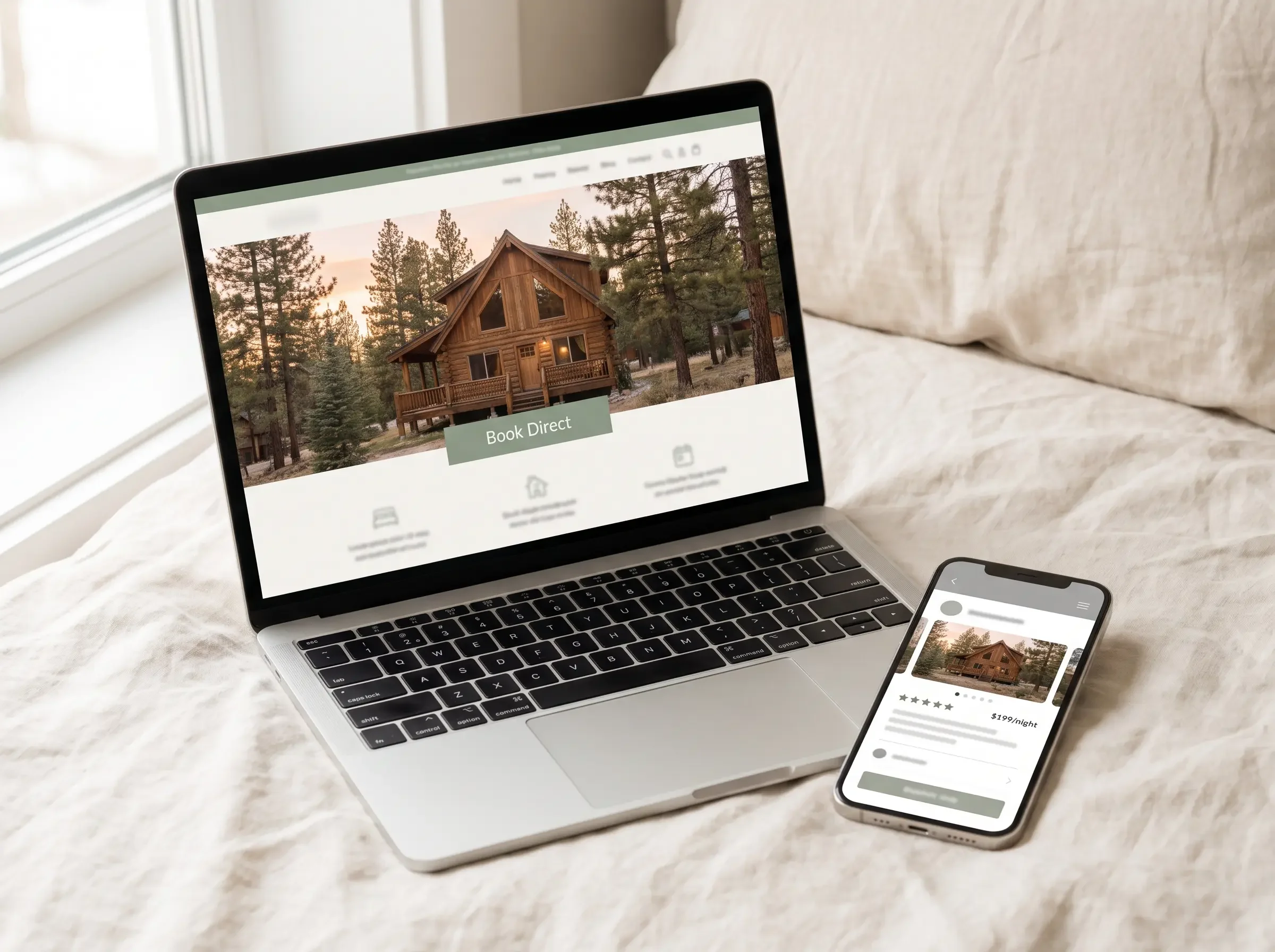
The data backs up how common that default is. Hostaway's 2026 Short-Term Rental Report found that nearly two-thirds of operators generate less than a quarter of their bookings directly, and a notable portion get none at all (Hostaway, 2026). That isn't a market where direct booking failed. The same report notes that most operators already have a direct booking website. Past guests come back through an email list and a reason to return.
A business owner treats that 15.5% as the cost of a channel they're actively working to diversify away from. A hobbyist pays it indefinitely and calls it the price of doing business, because building the alternative never made it onto the to-do list. If a direct site already exists and bookings are still slow, audit your brand before you blame the channel.
Common questions
Do I need to form an LLC to be a “real” business?
Not for the IRS's purposes. An LLC is a liability and tax-structure decision, separate from whether the activity counts as a business under the hobby-loss rules. That's a conversation for a CPA or an attorney, not something to settle from a blog post.
What's the fastest way to tell if I'm already there?
If the property has never had a rate change that wasn't just the platform's suggested pricing, and there's no record anywhere of what the last twelve months actually made after expenses, that's a hobbyist's setup — whatever the revenue number says.
Where does branding and a real website fit into this?
It's part of the same shift. A generic OTA listing is the visual equivalent of not keeping books — it works, but it builds nothing that compounds. A direct booking website is where that starts to change.
Where should I start if my rental still runs like a hobby?
The IRS test is retroactive — it's what an auditor applies after the fact. The more useful version runs the other direction: look at the property the way an owner running an actual business would, and fix whatever wouldn't hold up.
The STR Starter Audit is that read, done for you: your listing, website, guest journey, visibility and brand, with a ranked list of what to fix first.