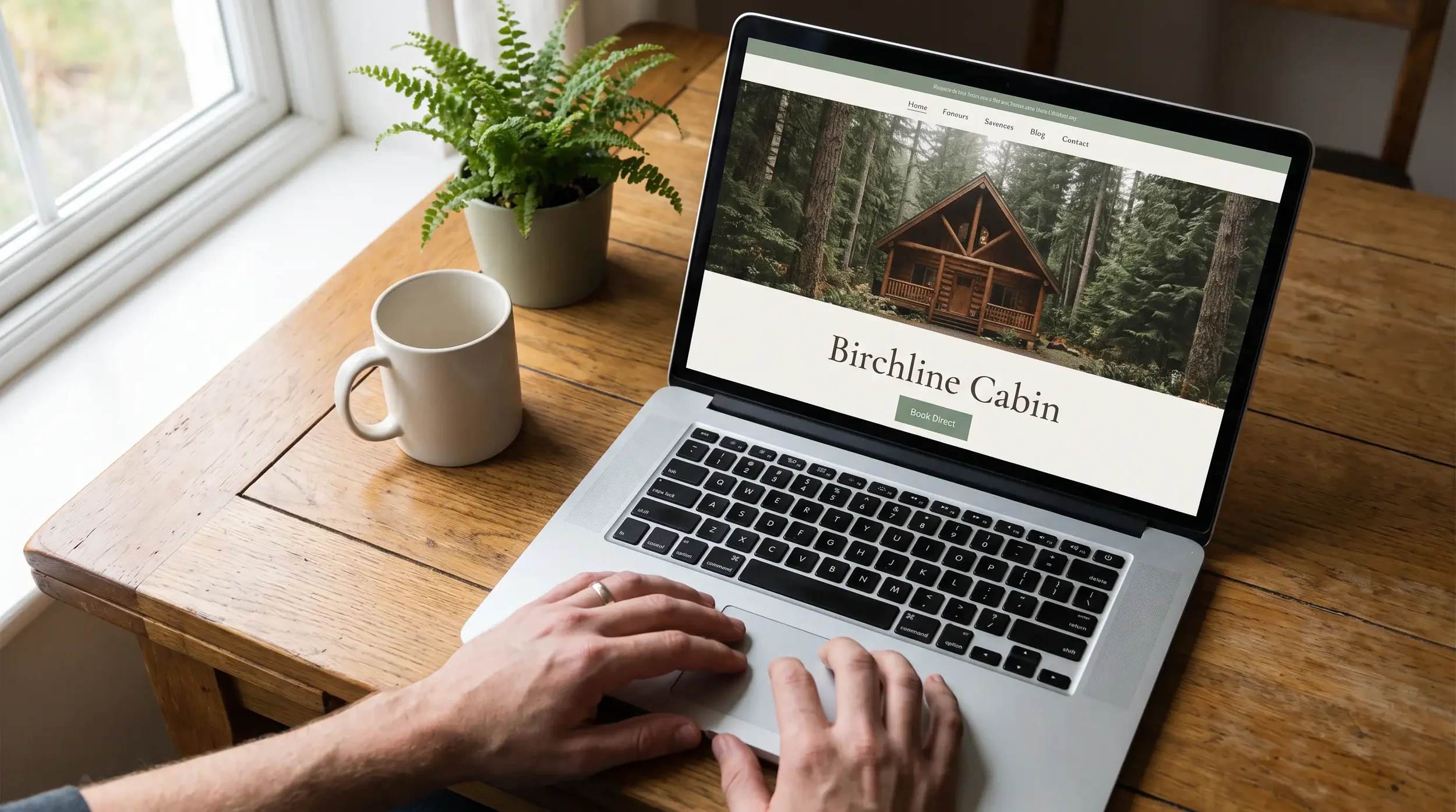
For a host running one to three properties, Squarespace is the better platform for a direct booking website. WordPress needs ongoing plugin updates, security patching, and hosting management that most solo hosts don't have time to run themselves. Squarespace bundles hosting, security, and commerce into one system, maintained by Squarespace, not by whoever's turning over units this weekend.
What's actually different between Squarespace and WordPress?
WordPress is open-source software. You install it on hosting you choose, then add plugins for the booking calendar, the payment gateway, the contact forms, and the security layer — every function beyond basic pages comes from a third party. That's what makes it flexible. It's also what makes you the one responsible for keeping all of it working and current.
Squarespace is a closed, hosted platform. Hosting, SSL, security patching, and commerce are built into the subscription, so there's no separate plugin stack to manage — the functions a direct booking website actually needs already live inside the platform. The trade is less raw customization for a system one person can run without a developer on call.
Where do WordPress direct booking sites actually break?
Security firm Patchstack tracks new WordPress vulnerabilities every year, and the pattern hasn't shifted: in 2025, 91% of the vulnerabilities found across the WordPress ecosystem were in plugins, not the WordPress core software itself. Plugins are the layer almost every WordPress site adds to actually function — and the booking calendar, the payment form, and the availability widget on a direct booking site are exactly the kind of plugin that report is describing.
This isn't a hypothetical risk category for an STR site. It's the plugins doing the booking work — the same ones a direct booking website depends on to take a reservation — that carry the exposure.
Why does the real cost show up in maintenance, not the software price?
WordPress hosting itself can be inexpensive, sometimes a few dollars a month. That price doesn't include someone watching for vulnerability disclosures and applying the patch before an automated bot gets to it first. Patchstack's own research puts the median time between a vulnerability going public and someone exploiting it at hours, not weeks. A host who logs into a dashboard once a month to update seasonal rates isn't positioned to patch a booking plugin the same day a new vulnerability goes public — and that gap, not a weak password, is where most WordPress sites actually get compromised.
Squarespace's patching runs on Squarespace's schedule, because it's their platform to maintain and it's already included in the subscription. You're not choosing between cheap and unmaintained or expensive and managed. The maintenance is already included.
Where does WordPress genuinely have the edge?
This isn't a one-sided case. WordPress offers more raw customization than Squarespace will ever offer, a larger plugin ecosystem for genuinely unusual functionality, and a lower baseline software cost if you're comfortable self-hosting. For an owner with a developer on retainer or an agency handling ongoing maintenance, that flexibility is a real advantage, and the security overhead above gets absorbed by someone whose job it is to watch for it.
That's not the buyer this comparison is written for. Most hosts running one to three properties don't have a developer on staff, and "WordPress is technically free" stops being true the moment you count what running it correctly — hosting, security monitoring, backups, someone applying patches fast — actually costs in time.
What does this mean for your booking flow specifically?
A direct booking website isn't a brochure. It's a live commerce surface — calendars, payment processing, guest data — running in the exact moments a booking either happens or doesn't: a guest checking dates on a weak hotel wifi connection, a gap-night promo going out to your list at 9 am on a Tuesday. Reliability at that moment matters in a way it doesn't for a static about page.
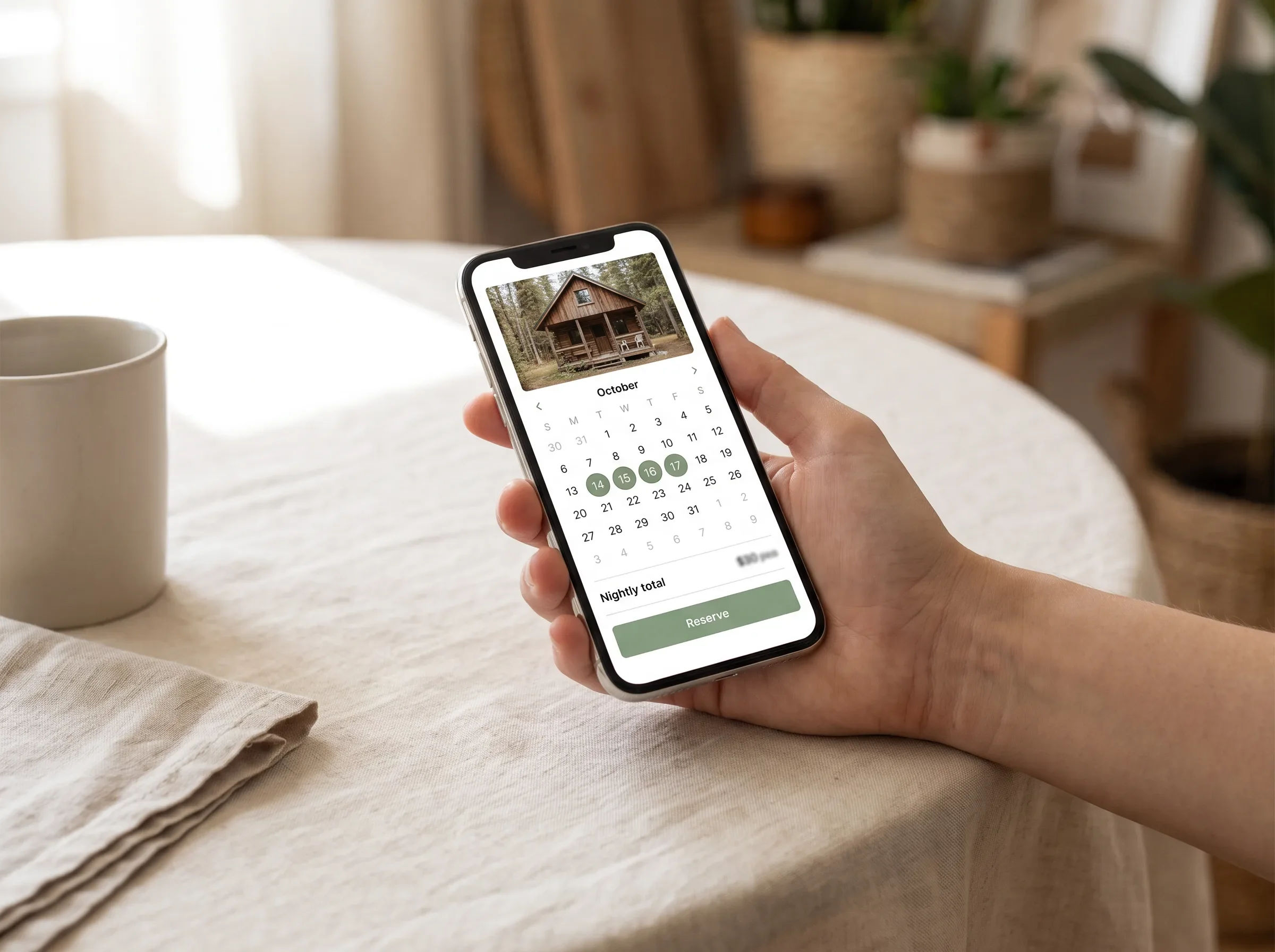
On a WordPress site, the calendar, the payment gateway, and the page itself are usually separate plugins that talk to each other, and any one of them going out of date can break the connection between a guest and their credit card. Squarespace's commerce is native to the platform serving the page — one system, not several plugins stacked on top of each other.
How does a PMS booking engine work inside a Squarespace site?
For most small hosts, the website doesn't run the booking. The property management software does: availability, rates, quotes, and payment. The website displays it, either as a widget embedded on the page or as a button that sends the guest to the PMS's hosted checkout.
On Squarespace, that embed goes into a Code Block. Squarespace allows JavaScript and iframes in Code Blocks on its Core, Plus, Advanced, Business, Commerce Basic, and Commerce Advanced plans, so confirm your plan before you count on an embedded calendar. Fjellsangin, my cabin near Mount Rainier, runs this setup: Hostfully as the PMS behind a Squarespace site, direct-booking only since July 2026.
The same embed works on WordPress, but there it sits next to a stack of other plugins, each one another update to track. If you change PMS later, on either platform, you swap the embed code and keep the domain and the pages. For more on which pieces stay yours, see what you actually own as a short-term rental host.
Common questions
Is Squarespace secure enough to take direct booking payments?
Squarespace includes SSL and handles its own platform patching. In most small-host setups, the PMS booking engine and its payment processor take the card, not the website. Ask your PMS which processor it uses.
Will switching platforms help my rental show up in AI search?
Not by itself. AI assistants and search engines read what's on your pages and how it's structured. The reasons most rental sites get skipped are covered in why AI search can't find your vacation rental website.
Is WordPress ever the right call for a host with one to three properties?
Yes, if a developer or agency already maintains the site under a contract that covers security updates. Without that contract, the same-day patching described above falls to you.
Where should you start?
We've built STR direct booking sites on Squarespace since 2017, and the pattern above is why. Every vacation rental website template in our Brand Edition line is built on Squarespace, so a host launches a direct booking website without inheriting a plugin stack to maintain on top of everything else running the property.
Not sure your current site can turn a guest who found you on an OTA into a direct booking? The STR Starter Audit scores exactly that, whichever platform your site is built on, along with your listing, guest journey, visibility and brand.